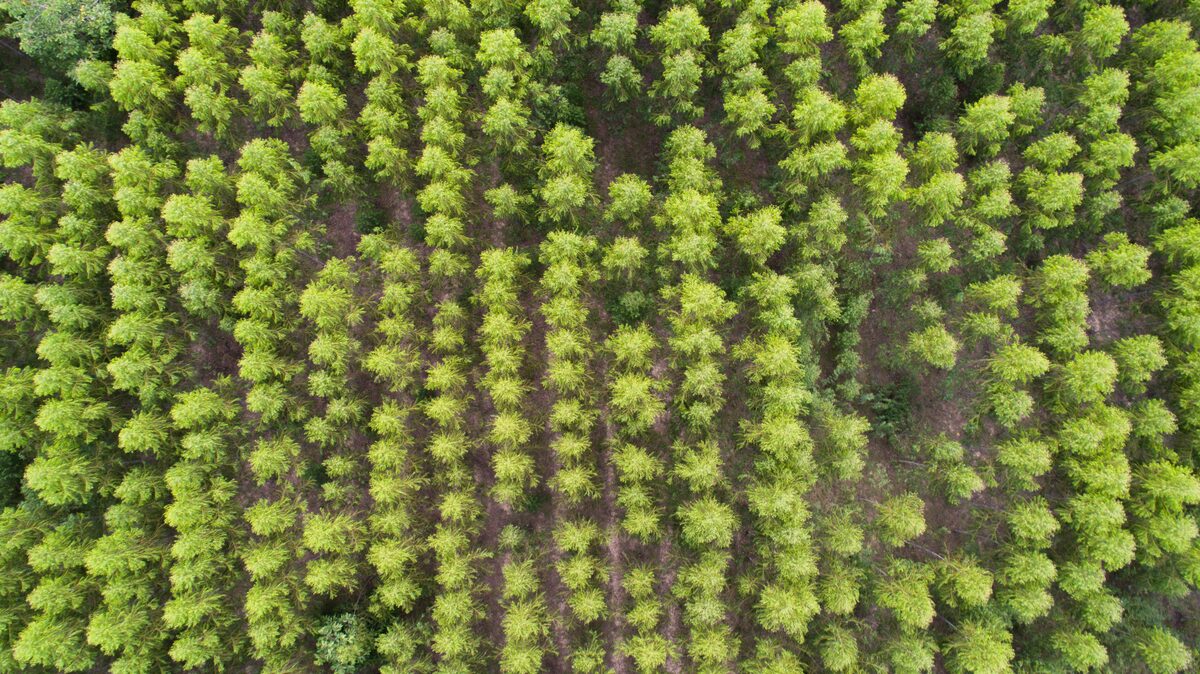
Timber’s most powerful feature as an asset class can be summed up in one sentence:Trees grow no matter what happens on the financial markets.Biological growth is the primary return driver and accounts for 65-75% of the total return of institutional Timber investments. It is independent of the capital market, physically measurable and mathematically predictable.
Whileour previous articlehas examined the institutional perspective on Timber — returns, risks, portfolio effects — this article delves deeper into the key return driver: biological growth. And using the practical example of Miro Forestry in West Africa, he shows why tropical climates fundamentally change the return equation.
Biological growth: The capital market-independent return driver
What makes biological growth so unique is its independence from external factors. A stock rises or falls with the expectations of market participants. A bond reacts to interest rate decisions. Even gold reacts to monetary policy and sentiment. But a tree grows — every day, every year, in every market phase. This fundamental property has far-reaching consequences for portfolio theory.
The effect is two-dimensional.Volume growth:Trees physically increase in mass and volume. A stand of pine trees in the United States typically grows at 3-5% of its volume per year. In tropical regions, this rate is 6-10% — a key advantage that we will analyze later.Ingrowth — the hidden value driver:As trees increase in diameter, they move through higher product classes. A 14 cm diameter log is pulpwood and fetches low prices. The same tree with a diameter of 24 cm becomes industrial wood with a significantly higher value. From a diameter of 34 cm it is sawn timber - a premium product with the highest price per cubic meter. This automatic “upgrading” multiplies the volume effect with a price effect.
For portfolio theory this means: Timber generates onepositive expected return that increases with the holding period and is independent of financial market cycles. This is a feature that no other asset class offers — and the main reason for the historically low correlations with stocks and bonds.
The natural hedge: Why declines in wood prices do limited damage
The second notable property of biological growth is its function asnatural hedge against price declines. During phases of falling wood prices, biological growth compensates for the price decline on three levels.
First throughVolume accumulation: As the price per cubic meter falls, the amount of wood available increases. With a volume growth of 4% p.a. and a price decline of 3%, the net increase in value remains positive. Second throughIngrowth compensation: Even if the price per cubic meter stagnates, the value per log increases due to the shift to higher product classes. Thirdly, through theHarvest option: Management can reduce or suspend the harvest and leave the wood standing during low price periods. The trees continue to grow in volume and value — a luxury that no commodity ETF offers.
Historically, real wood prices rose by about2% annuallyover the last century. Combined with biological growth, this results in a long-term real increase in value of 5-7% p.a. - before land value changes or active management are taken into account.

Miro Forestry: Timber investment in West Africa
Miro Forestry Developments Limited, based in London, is a commercial forestry company operating in West Africa — Ghana and Sierra Leone. With a combined land holding of31,754 hectares(9,637 ha in Ghana, 22,117 ha in Sierra Leone) Miro is one of the largest sustainably managed timber producers in West Africa.
The investment structure shows typical characteristics of institutional Timber investments: total investment of USD 28.1 million, financed by mezzanine debt (USD 6 million) and equity (USD 22 million). The investor base includes private investors (USD 2 million), family offices (USD 6 million) and institutional investors (USD 30 million in commitments). The share price increased from USD 8.00 (2014) to USD 12.00 (2017) — a 50% increase in value in three years, driven primarily by the growth of biological assets.
The growth prospects are ambitious: From 4,047 planted hectares (2015), Miro plans to expand to 36,223 hectares by 2030. The company value is expected to increase from USD 27 million (2015) to over USD 250 million (2025) - with the first significant income from 2025.
The crucial thing is: Miro developedfallow land, which was formerly rainforest — instead of relying on existing investable timberland. This distinguishes the business model from North American TIMOs and opens up access to a market that has hardly been tapped yet.
The tropical advantage: faster growth, higher returns
The fundamental advantage of West African timber investments lies in theclimate. Tropical tree species grow significantly faster than their counterparts in temperate zones. While a pine tree in the USA takes 25-35 years to reach harvest maturity, tropical species such as teak, gmelina and eucalyptus in West Africa reach harvest maturity in 10-20 years.
This has a direct impact on the return equation:Higher annual volume growth— Tropical plantations achieve growth rates that are 2-3 times higher than those in temperate climate zones.Faster cash flow cycle— first thinning revenues after 5-7 years, main harvest after 10-15 years instead of 25-35 years.More stable biological production— the warm and humid climate all year round enables continuous growth without seasonal interruption.
For institutional investors this means: With comparable biological growth per year, the tropical climate significantly shortens the duration of the investment. The internal rate of return (IRR) benefits directly — previous cash flows have a higher weight in the present value calculation.
At the same time, regional demand for wood products in West Africa is high and growing. Urbanization, population growth and economic development are driving demand for wood — while natural forests are shrinking due to deforestation and conversion to agricultural land. The supply-demand relationship systematically shifts in favor of timber producers.
Risk management in emerging markets: The Miro strategy
Timber investments in West Africa offer higher return potential, but also require more comprehensive risk management than investments in established markets. Miro has identified and addressed three key risk categories:
Commercial risks:These include timber price fluctuations, exchange rate risks (local currencies vs. USD) and market development. Miro addresses this through diversification across two countries (Ghana and Sierra Leone), focused marketing in local and regional markets and flexibility in harvest timing.
Environmental risks:Biotic risks (pests, diseases) and climatic risks (drought, fire) are minimized through professional forest management with over 1,000 employees. Diversification across different locations and tree species reduces concentration risk. Sustainable management according to international standards protects biological productivity in the long term.
Social and political risks:Operations in developing countries require active stakeholder management. Miro invests in local communities, employs local workers and collaborates with government agencies. Being present in two different countries diversifies political risk.
The balance sheet shows that professional management can effectively manage the specific emerging market risks — while the higher biological growth rates and favorable demand trends serve as compensation.
Timber and Inflation: The Natural Hedge
One aspect that makes Timber particularly relevant for the current market phase: Timber is anatural inflation hedge. The connection works across multiple channels.
Lumber prices correlate strongly with the CPI:As a building material and industrial raw material, wood prices tend to rise with the general increase in price levels. Historically, lumber prices have correlated with the rate of inflation — a protection that neither bonds nor cash provide.Land values rise with inflation:As the Washburn study shows, the strongest indicators of real land value changes are the CPI and the nominal risk-free rate — both inflation-sensitive measures.Biological growth is immune to inflation:Since trees grow physically, regardless of monetary policy and price levels, the real value contribution of biological growth is preserved in inflationary phases.
In combination with our analysis forMonetary policy and the five inflation scenariosTimber thus becomes the third pillar of an inflation-resistant portfolio strategy - alongsideGold (25%)and raw materials. Timber complements these asset classes with its unique biological return driver, which remains positive even in deflation scenarios.
When you apply this knowledge, you gain a concrete advantage over competitors who enter investor conversations without this foundation. Use the insights from this article as the basis for your next step.
Conclusion: Biological growth as a unique selling point
Timber investments — whether in the US, Europe or West Africa — have one characteristic that fundamentally distinguishes them from any other asset class:Biological growth generates returns independent of capital markets.Trees grow in boom times and in crises, in inflation and deflation, in interest rate cuts and interest rate increases.
For investors seeking true diversification — not the illusion of asset classes that suddenly correlate during crises — Timber offers the ultimate building block: a return driver that is structurally independent of the financial system. The tropical model, as implemented by Miro Forestry in West Africa, adds higher growth rates and faster cash flow cycles - with appropriate professional risk management.
The long-term benefits of Timber are based primarily on biological growth, not on the expectation of rising timber prices. This makes Timber one of the few asset classes whose return forecast is based on scientific laws - and not just on historical financial data. For institutional investors seeking stability, inflation protection and true portfolio diversification, Timber is a mathematical and environmental necessity.
